【45th Talk】Associate Professor Dr. Kornphanat Tungkeunkunt: “Listening to the Past: Chinese Sound and Broadcasting in Postwar Bangkok”
Upcoming Event
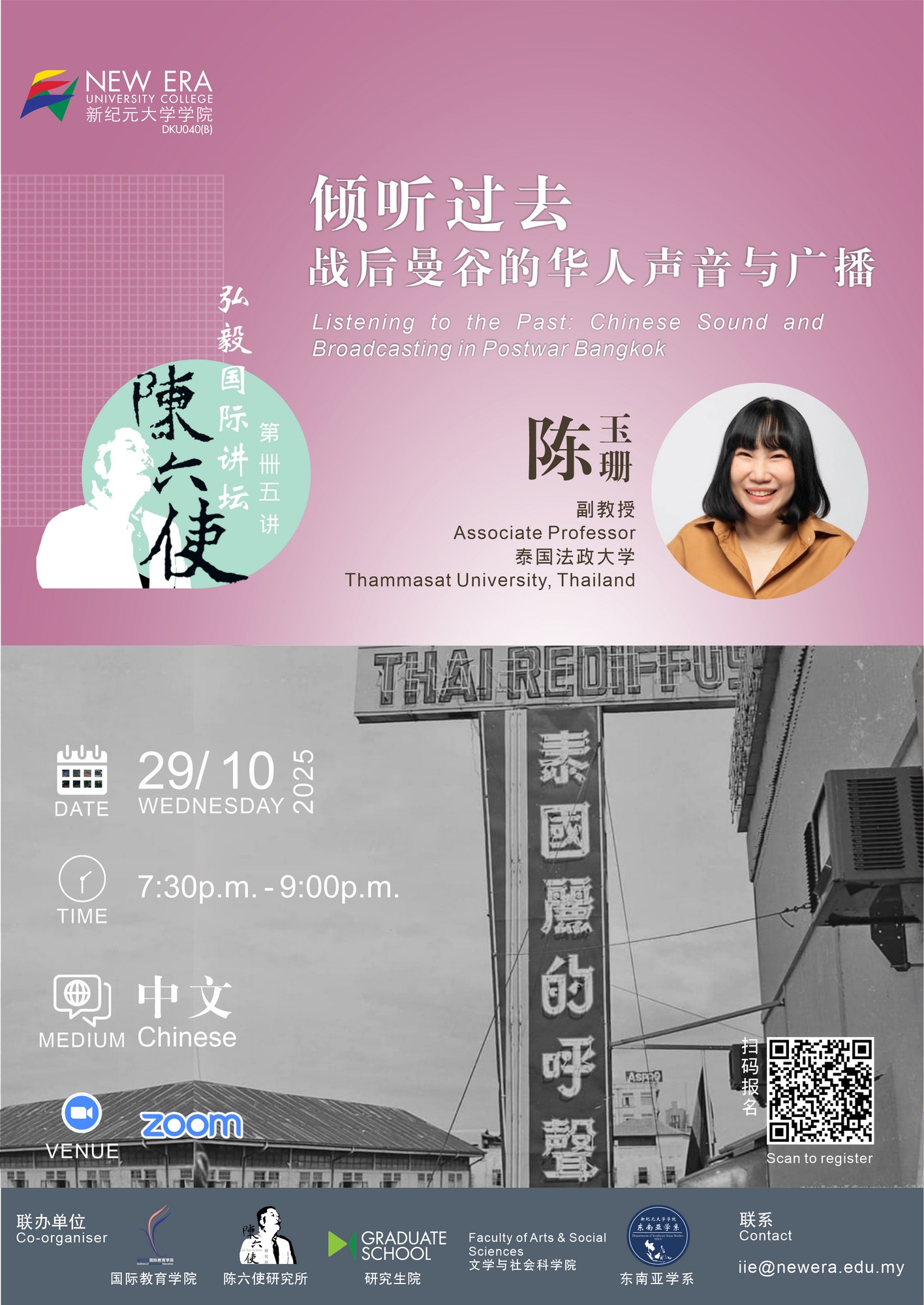
| Introduction | The 45th session of the “Tan Lark Sye Lecture Series,” organized by the Institute of International Education and the Tan Lark Sye Institute at New Era University College is now open for registration. In this lecture, Associate Professor Kornphanat Tungkeunkunt from Thammasat University, Thailand, will explores Rediffusion—known in Chinese as 丽的呼声 from a historical perspective. As the only legal Chinese-language radio station in Thailand, Rediffusion played a unique role in shaping the auditory experiences of Bangkok's Chinese community in the postwar era. The talk aims to examine how this broadcasting technology was introduced to Bangkok after World War II and how it brought a diverse range of audio content to the local Chinese population. It also investigates how, between the 1950s and 1970s, sound technology crossed and redefined spatial boundaries, profoundly influencing the auditory culture of the Chinese community. The lecture will further explore the critical role of sound in facilitating social interaction and cultural transmission during this period. |
| Speaker | Associate Professor Dr. Kornphanat Tungkeunkunt (Thammasat University, Thailand) Dr. Kornphanat Tungkeunkunt is an Associate Professor at the Faculty of Liberal Arts, Thammasat University, Thailand. She holds a PhD in Chinese Studies from the National University of Singapore. A Thai-Chinese scholar, Dr. Tungkeunkunt teaches history and general education courses with a focus on cross-cultural and transnational perspectives. Her research explores the intersections of Chinese, Thai, and Southeast Asian cultural networks, with recent publications including “Chinese Cinema in Bangkok from the 1950s to the 1970s: Industry, Market and Network” (Malaysian Journal of Chinese Studies, 2023); “Sinophone Thainess: The Problematic Landscape of Creolization in the Thai-Chinese Translation Zone” (Routledge, 2023, co-authored with Gritiya Rattanakantadilok); “(Re-)narrating the Evolution of the Lanchang-Mekong Cooperation: China’s Diplomacy Behind the Scenes” (Strategic Analysis, 2022, co-authored with Poowin Bunyavejchewin); and “(Re)Diffusion of Beautiful Sound: Chinese Broadcast in Post-war Bangkok” (Routledge, 2022). Through her teaching and scholarship, Dr. Tungkeunkunt continues to bridge linguistic, cultural, and disciplinary boundaries in the study of Chinese and Southeast Asian societies. |
| Moderator | Associate Professor Dr. Lew Siew Boon (Institute of International Education, NEUC) Dr. Lew received her PhD from the National University of Singapore and is currently the Assistant Dean at the Institute of International Education, New Era University College, as well as the Head of the International Academic Exchange Office. Her main research interests include folklore and folk culture, and the history of Chinese communities in Singapore and Malaysia. She has published several works, including Discovering the Goddess of Mercy in Swee Nyet Temple of Pulai, Kelantan and Hakka in China and Southeast Asia: Cross-Regional Field Work and Essays (co-authored). She has also published more than 20 academic papers. |
| Information | Date: 29 October 2025 (Wednesday) Time: 7:30 PM – 9:00 PM Venue: ZOOM (ID & password will be sent to your mobile number and email) Registration Form: https://bit.ly/3seNHqc Registration is free. Please complete your registration by Tuesday, 28 October 2025. |
Trailer (Video)
Lecture Postscript
The 45th session of the Tan Lark Sye Lecture Series, hosted by New Era University College’s Institute of International Education and the Tan Lark Sye Institute, took place on 29th October 2025. Guest speaker Dr. Kornphanat Tungkeunkunt, Associate Professor at Thammasat University’s Faculty of Liberal Arts, brought fresh insights with her talk titled “Listening to the Past: Chinese Sound and Broadcasting in Postwar Bangkok.” Drawing from her extensive research, Dr. Kornphanat Tungkeunkunt explored how radio technology introduced in Bangkok after World War II, reshaped the auditory landscape of the city’s Chinese communities. Far beyond a tool for news, radio became a cultural lifeline, connecting scattered groups and reinforcing shared identity through sound.
Dr. Kornphanat Tungkeunkunt, a scholar with both Thai and Chinese heritage, teaches history and general education at Thammasat University and holds a PhD in Chinese Studies from the National University of Singapore. Her research delves into transnational and multilingual exchanges within the cultural networks of China, Thailand, and Southeast Asia. She has published extensively on topics such as Chinese-language Cinema in Bangkok from the 1950s to the 1970s: Industry, Market and Network” (Malaysian Journal of Chinese Studies, 2023); “Sinophone Thainess: The Problematic Landscape of Creolization in the Thai-Chinese Translation Zone” (Routledge, 2023, co-authored with Gritiya Rattanakantadilok); “(Re-)narrating the Evolution of the Lanchang-Mekong Cooperation: China’s Diplomacy Behind the Scenes” (Strategic Analysis, 2022, co-authored with Poowin Bunyavejchewin); and “(Re)Diffusion of Beautiful Sound: Chinese Broadcast in Post-war Bangkok” (Routledge, 2022). Through her teaching and research, Dr. Kornphanat Tungkeunkunt actively promotes cross-cultural and interdisciplinary dialogue among Chinese, Thai, and English-speaking academic communities, striving to deepen regional cultural understanding and scholarly exchange.
During the session, Dr. Kornphanat Tungkeunkunt emphasized how radio broadcasting helped define public and private spaces for Chinese listeners in Bangkok, creating a collective memory through sound. Her reflections sparked vibrant discussion during the Q&A, where attendees discussed topics ranging from the current state of Chinese-language media in Thailand to the dynamics of radio broadcasting during the Cold War.
The session was moderated by Associate Professor Dr. Wong Wai Shee, Head of the Chinese Language and Literature Department at New Era University College, and drew an audience of over 140 participants.


