
【6th Talk】Dr. Zeng Xiaoxia: Sweet Potato and the Fujian-Taiwan Connection: An Interdisciplinary Study from Crop Diffusion to Identity Formation
Upcoming Event
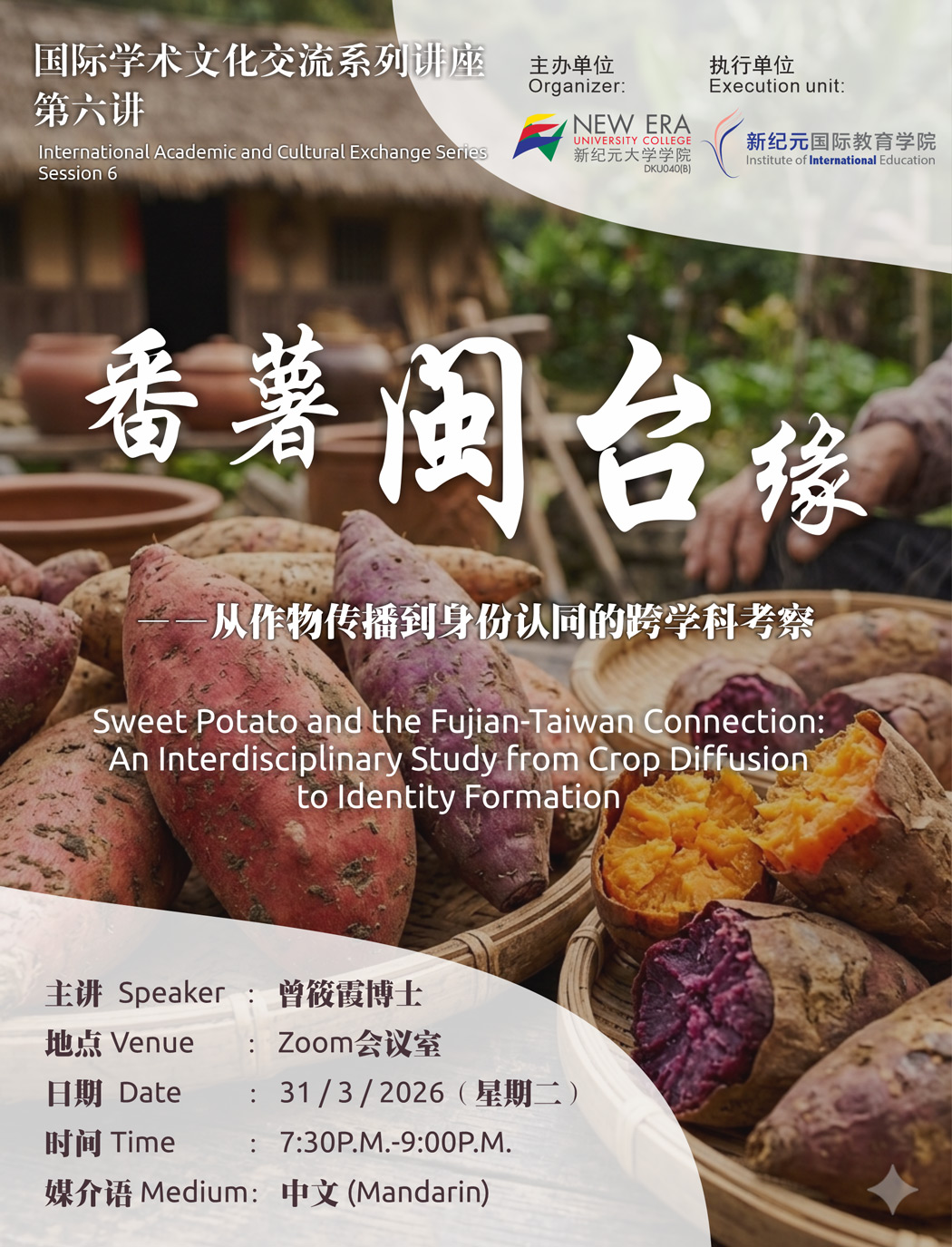
| Introduction | Introduction: Organized by New Era University College and planned by Institute of International Education, the " International Academic and Cultural Exchange Series " lectures will be held periodically throughout 2026. The series invites esteemed scholars and experts from both domestic and international institutions who have made significant achievements in their respective research fields. The sixth lecture of this series will be delivered by Dr. Zeng Xiaoxia, a cultural scholar from Fuzhou University. Titled “Sweet Potato and the Fujian-Taiwan Connection: An Interdisciplinary Study from Crop Diffusion to Identity Formation,” the lecture takes the sweet potato as its point of departure and adopts an interdisciplinary perspective to explore the material carriers and symbolic meanings of Minnan–Taiwan cultural identity. Drawing on global history, cultural ecology, sociolinguistics, and memory studies, it examines the transmission route of the sweet potato from the Andes to Fujian and Taiwan, the process of technological localization, mechanisms of ecological adaptation, and the construction of cultural identity. |
| Speaker | Zeng Xiaoxia Dr. Zeng Xiaoxia is a cultural scholar at Fuzhou University and a doctoral supervisor in Chinese Studies at New Era University College. Her research areas include Chinese art, aesthetic studies, and Maritime Silk Road studies. Her representative works Fujian Through Foreign Eyes (Zhonghua Book Company, 2010), Zeng Xiaoxia Interprets International Cinema (New York Business Media, 2014), and Maritime Fuzhou (Straits Literature and Art Publishing House, 2017), among others. |
| Moderator | Pua Shiau Chen Dr. Pua Shiau Chen is an Associate Professor at the Institute of International Education, New Era University College, holding a Ph.D. in Literature with research expertise in aesthetics and cultural studies. She has published more than thirty academic articles in domestic and international journals, including “An Examination of the Concept of ‘Qing’ and ‘Qing Music,’” “The Poetic Construction and Implications of Qu Yuan’s ‘Wandering,’” “Celestial Imagery in ‘Odes of Jiaomiao,’” and “The Humor and Satirical Aesthetics in Huang Yao’s Folk Paintings.” More than thirty papers have been presented at academic conferences locally and internationally. She also contributed to the compilation of the Encyclopedia of Buddhist Culture in Hangzhou. |
| Information | Date: 31 March2026 (Tuesday) Time: 7:30 PM to 9:00 PM Venue: Zoom Meeting Room Link: https://newera-edu-my.zoom.us/j/8266571752 Meeting ID: 8266571752 (Password: 018871) Language: Chinese |
Lecture Postscript
Organized by New Era University College(NEUC) and planned by the Institute of International Education, the sixth lecture in the “International Academic and Cultural Exchange Series” was held on March 31, 2026. The speaker for this session, Dr. Zeng Xiaoxia, a cultural scholar from Fuzhou University, delivered a lecture titled “Sweet Potato and the Fujian-Taiwan Connection: An Interdisciplinary Study from Crop Diffusion to Identity Formation”. The session was moderated by Assoc. Prof. Dr. Pua Shiau Chen from the Institute of International Education, NEUC. The event attracted an audience of nearly 61 participants, including faculty members, postgraduate students, and members of the public.
Dr. Zeng Xiaoxia is currently a cultural scholar at Fuzhou University and a doctoral supervisor in Chinese Studies at NEUC. She earned her PhD at NEUC, and received an award for her outstanding thesis. Her research focuses on Chinese art, aesthetic studies, and Maritime Silk Road studies. Her representative works include Fujian Through Foreign Eyes, Zeng Xiaoxia Interprets International Cinema, and Maritime Fuzhou, among others.
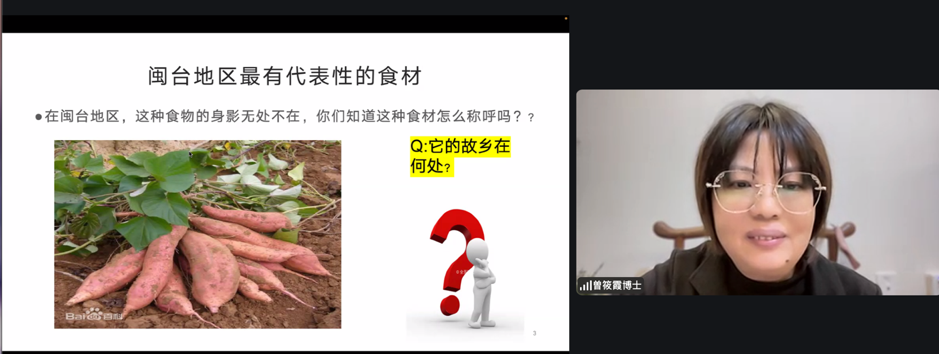
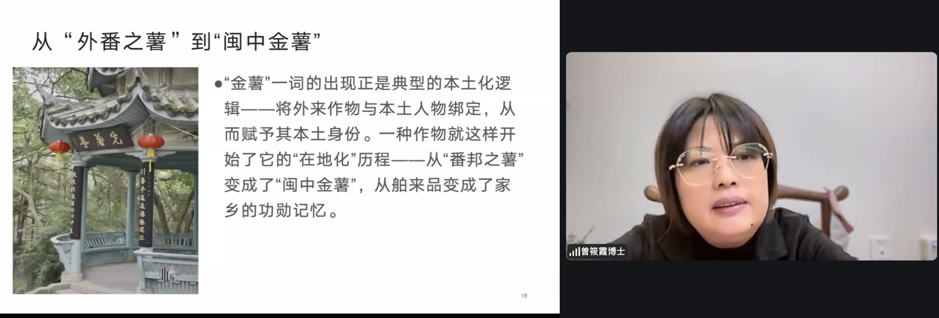
From an interdisciplinary perspective, Dr. Zeng analysed crops, identity, and the formation of transregional communities. She pointed out that the sweet potato culture in Fujian and Taiwan has undergone three distinct stages: from a famine-relief crop, to a form of “ancestral memory,” and eventually to an “ethnic symbol.” The cultural identity of the sweet potato, she argued, has been constructed cumulatively over time. This process demonstrates that crops do not inherently possess cultural meaning; rather, their symbolic value is gradually shaped through historical development. The lecture sparked strong interest and lively discussion among students regarding sweet potato culture.