
21th Book Sharing: Theme: Mastering Literature Review
Upcoming Event
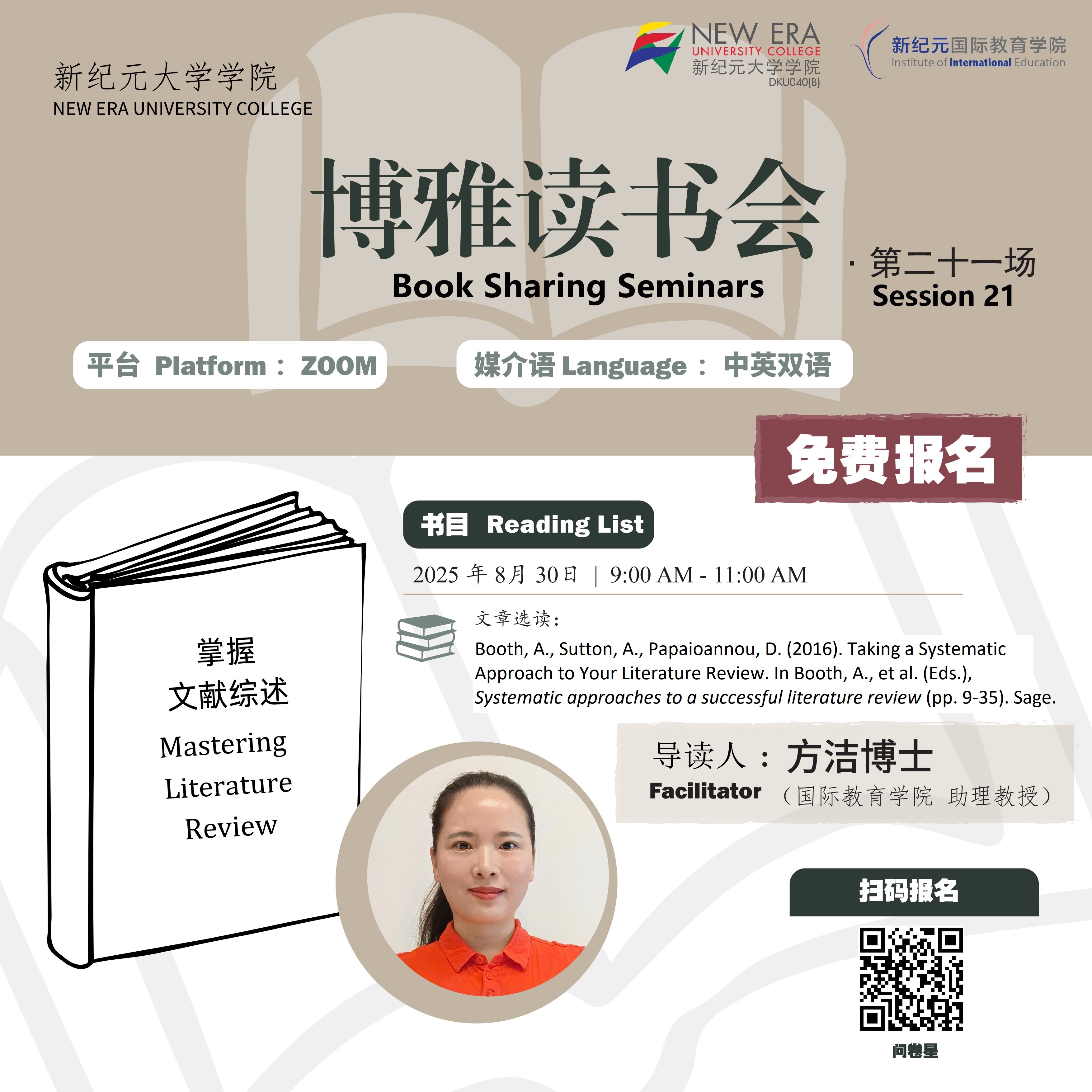
| Introduction | To help students master the writing methods of systematic literature reviews, this reading session will focus on providing guidance on specific writing techniques. By analysing examples of systematic literature reviews, it aims to guide students in understanding the core logic and writing skills of literature reviews. Many students often struggle with merely listing sources instead of systematically integrating and critically analysing them. This session will teach students how to precisely define research topics, search for literature, filter materials, and establish a clear line of argumentation. Through a combination of case studies and interactive practice, participants will not only learn the standard writing norms of literature reviews but also develop a problem-oriented academic mindset. Ultimately, this will help them transition from passively "reading literature" to actively "using literature." Whether you are a postgraduate student working on a dissertation or an undergraduate looking to enhance your academic writing skills, this event will provide practical research methods. |
| Speaker | Asst. Prof. Dr. Fang Jie Fang Jie is currently an Assistant Professor at the Insitute of Interrnational Education of New Era University College. She earned her Ph.D. from the University of Malaya, specializing in teacher training and educational science. Her research focuses primarily on teaching Chinese as a second language and the application of educational technology, with in-depth work in Mobile-Assisted Language Learning (MALL). She has published first-author papers in ESCI and Scopus-indexed journals. With extensive experience in teaching Chinese, Fang Jie has taught at multiple universities and international schools in China and Malaysia. She is dedicated to promoting the integration of international Chinese education and educational technology. |
| Reading Material | Booth, A., Sutton, A., Papaioannou, D. (2016). Taking a Systematic Approach to Your Literature Review. In Booth, A., et al. (Eds.), Systematic approaches to a successful literature review (pp. 9-35). Sage. |
| Seminar Information | Date: Saturday, August 30, 2025 Time: 9:00 AM – 11:00 AM Platform: Zoom Registration Link: https://tinyurl.com/bp4uyeav *Free registration, due by August 28, 2025. |
Book Sharing Postscript
On August 30, 2025 (Saturday) at 9:00 AM, the School of International Education at New Era University College successfully hosted a lecture titled “Mastering Literature Reviews: Strategies and Methods for Academic Papers and Systematic Reviews.” The session was delivered by Dr. Fang Jie, Assistant Professor at the School of International Education, and attracted approximately 40 participants, including postgraduate students, lecturers, and researchers.
During the lecture, Dr. Fang presented a systematic overview of the essential components and practical approaches involved in conducting a literature review. She stressed that a literature review is not a simple compilation of sources but a comprehensive, critical, and structured synthesis of existing scholarship. Its purpose, she noted, is to identify research gaps, establish research positioning, and provide the theoretical grounding for new studies. Dr. Fang also highlighted that a high-quality literature review should demonstrate selectivity, thematic focus, critical engagement, and synthesis.
Dr. Fang introduced various types of literature reviews, including narrative reviews, systematic reviews, scoping reviews, meta-analyses, and meta-syntheses. Drawing on examples from education and the social sciences, she explained the appropriate application scenarios and writing conventions for each type. Additionally, she shared practical guidance on using reference management tools such as Zotero and Mendeley, as well as the ways AI tools can support literature screening, note organization, and thematic synthesis to enhance research efficiency. She also reminded participants of key academic writing conventions, including avoiding personal pronouns, using reporting verbs, maintaining an objective tone, and ensuring proper citation practices.
The lecture was rich in content and clearly structured, enhancing participants’ understanding of literature review methodologies and equipping them with essential skills for future academic writing and research projects. The event concluded with an engaging Q&A session and was well received by all attendees.

