
【51st Talk】Assoc. Prof. Dr. Yeh Er-jian: Subordination and Agency in a Cross-Imperial Network: Japanese-Philippine Forestry Knowledge Production and Actors in Colonial Taiwan
Upcoming Event
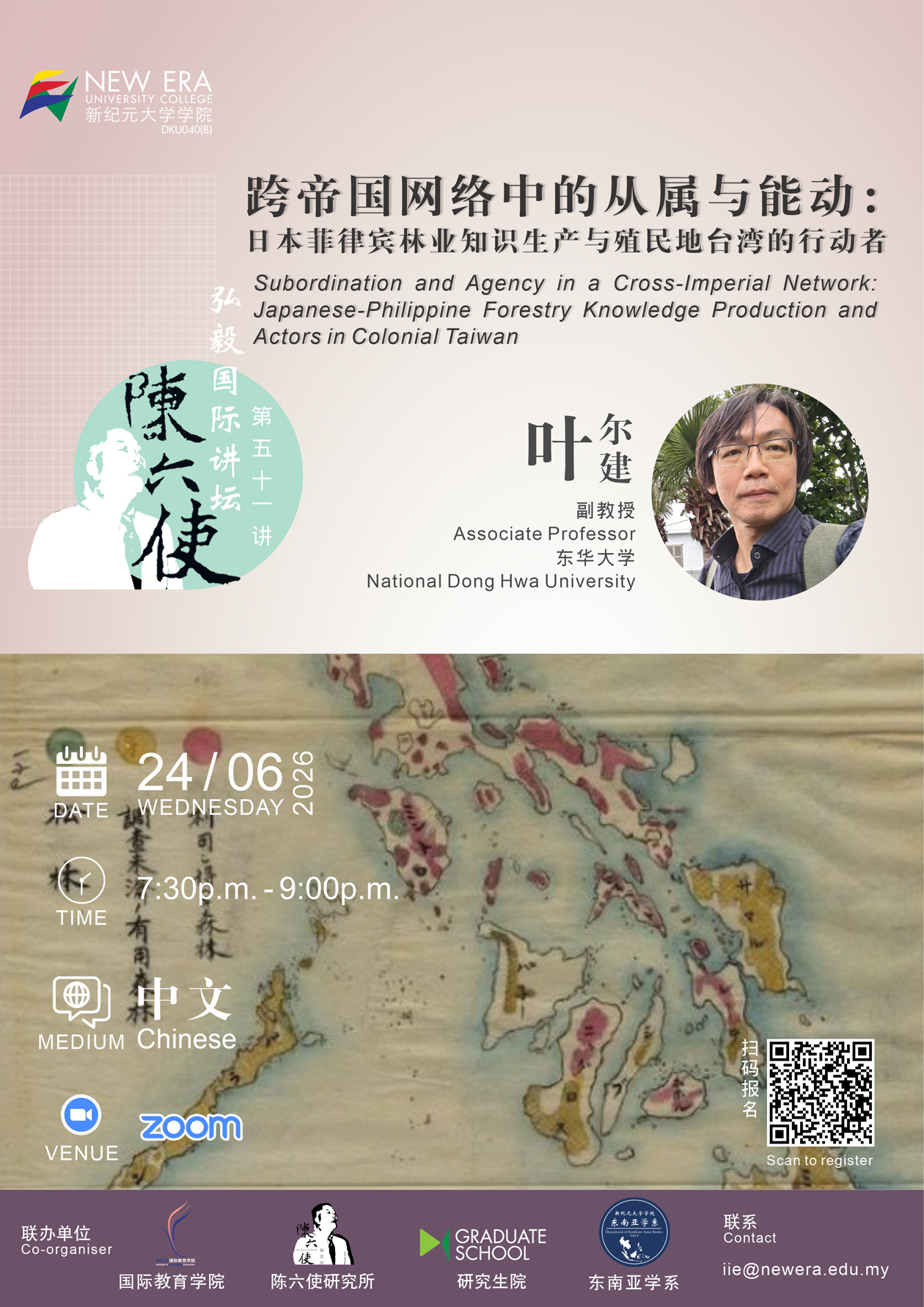
| Introduction | The 50th session of the “Tan Lark Sye Lecture Series,” organized by the Institute of International Education and the Tan Lark Sye Institute at New Era University College is now open for registration. In this lecture, Assoc. Prof. Dr. Yeh Er-jian from National Dong Hwa University will examine forestry knowledge production in Japan and the Philippines, with a focus on the role of colonial Taiwan. Since the 1910s, as Japan’s demand for timber grew, Taiwan became a crucial hub in gathering forestry intelligence from the resource-rich Philippines. Through a “cross-imperial network” linking Japan, the United States, Taiwan, and the Philippines, Taiwanese professionals conducted forestry surveys that significantly shaped Japan’s understanding of Philippine forestry. The lecture will explore how Taiwanese actors navigated the tensions between local initiative and imperial control, offering new perspectives on inter-imperial interactions and the history of forestry and knowledge exchange in East and Southeast Asia. |
| Speaker | Assoc. Prof. Dr. Yeh Er-jian (National Dong Hwa University) Dr. Er-jian Yeh is Associate Professor in the Department of Taiwan and Regional Studies at National Dong Hwa University. He received his PhD in Geography from Durham University, UK. His research focuses on historical geography and regional geography, with particular interest in how historical actors,including colonial bureaucrats, scientists, Chinese merchants, and local communities, produced, transmitted, and practiced knowledge within complex power structures. Dr. Yeh has led a number of research projects, including the Hakka Cultural Research Project at Academia Sinica, the Nantou City Chronicle, and the Revised Mingjian Township Chronicle. His publications include Colonial Actors in Dualities: Japanese Research on Colonial Era Philippine Forestry and articles on agricultural exchange, Chinese merchant networks, forestry, and regional development in East and Southeast Asia. Notable works include “Fruits and Vegetables from China: The Historical Geography of Agricultural Exchange in the Northwest Pacific Region during the Early Twentieth Century,” “The Historical Geography of Chinese Merchants’ Activities in the Philippines during the Early American Period (1900s–1930s),” “Agricultural Knowledge Exchange between Japanese-Ruled Taiwan and the American Philippines in the Early Twentieth Century,” and “Natural Improvement, Social Mobilization, and Regional Formation in Yuli during the 1920s.” |
| Moderator | Assoc. Prof. Dr. Pek Wee Chuen (New Era University College) Dr. Pek Wee Chuen is Associate Professor in the Department of Chinese Language and Literature and Head of the Department of Southeast Asian Studies at New Era University College. He received his PhD in Geography from National Taiwan Normal University. He also serves as a Geography Curriculum Consultant for Dong Zong and Academic Director of the Centre for Malaysian Chinese Studies. His research focuses on the regional geography and social development of Malaysia, particularly Malaysian Chinese society. He is the author of several books, including The Transformation and Integration of Chinese Society in Johor Bahru: 1855–1942, The Nanyang Code on the Equator, and Farewell to Tangshan: Rebirth in the Exotic Land of the Malay Peninsula. He has also published numerous academic articles on Malaysian society, history, and geography. |
| Information | Date: 24 June 2026 (Wednesday) Time: 7:30 PM – 9:00 PM Venue: ZOOM (ID & password will be sent to your mobile number and email) Registration Form: https://bit.ly/3seNHqc Registration is free. Please complete your registration by Tuesday, 23 June 2026. |
Trailer (Video)
Lecture Postscript
The 51st session of the Tan Lark Sye Lecture Series, organized by the Institute of International Education and the Tan Lark Sye Institute of New Era University College (NEUC), was held on 24 June. The session featured AssociateProfessor Dr. Yeh Er-jian from National Dong Hwa University, as the guest speaker, delivering a lecture titled “Subordination and Agency in a Cross-Imperial Network: Japanese-Philippine Forestry Knowledge Production and Actors in Colonial Taiwan”. The lecture was moderated by Assoc. Prof. Dr. Pek Wee Chuen, Head of the Department of Southeast Asian Studies at New Era University College, and attracted more than 150 participants. In the lecture, Assoc. Prof. Yeh examine the trans-imperial network connecting Japan, the United States, Taiwan, and the Philippines, analyzing how Taiwan participated in forestry surveys in the Philippines. His talk will explore how Taiwan exercised agency in the production of knowledge while simultaneously operating within the power structure of the central government in Tokyo.
Associate Professor Yeh Er-jian, holds a PhD in Geography from Durham University, United Kingdom. He has led several major research projects, including the Hakka Cultural Studies Project at Academia Sinica, the Nantou City Gazetteer, and the Revised Mingjian Township Gazetteer.
His research focuses on historical geography, colonial history, environmental history, and the circulation of knowledge. His work examines how historical actors, including colonial bureaucrats, scientists, Chinese merchants, and local communities, produced, disseminated, and applied knowledge within complex and overlapping power structures. Adopting a trans-imperial perspective, he reinterprets the historical development of East and Southeast Asia through the lens of interconnected imperial networks. His scholarship has significantly advanced academic discussions on trans-imperial networks, colonial knowledge production, and regional historical geography. His research offers important historical insights and makes substantial contributions to the study of the colonial history of East and Southeast Asia.
During the lecture, Assoc. Prof. Yeh focused on the formation and circulation of forestry knowledge during the expansion of the Japanese Empire. He explored how Japan, the Philippines, and colonial Taiwan were connected through trans-imperial networks that facilitated the exchange and implementation of forestry knowledge, technologies, and institutions. He argued that colonial knowledge did not flow unidirectionally from the imperial center to its colonies. Rather, it was continuously circulated, reconfigured, and reproduced among different colonial territories, giving rise to knowledge networks that transcended both geographical and imperial boundaries.
Following the lecture, participants and moderator actively engaged with the speaker during the Q&A session, raising questions related to the research design and methodology. The exchange further strengthened the institution’s mission to advance academic research and foster cross‑disciplinary collaboration.


