【15th Talk】An Exclusive Lecture by Prof. Dr. Voon Phin Keong: “Outcome-Based Education and Confucian Education Concepts: Vision and Mission”
Upcoming Event
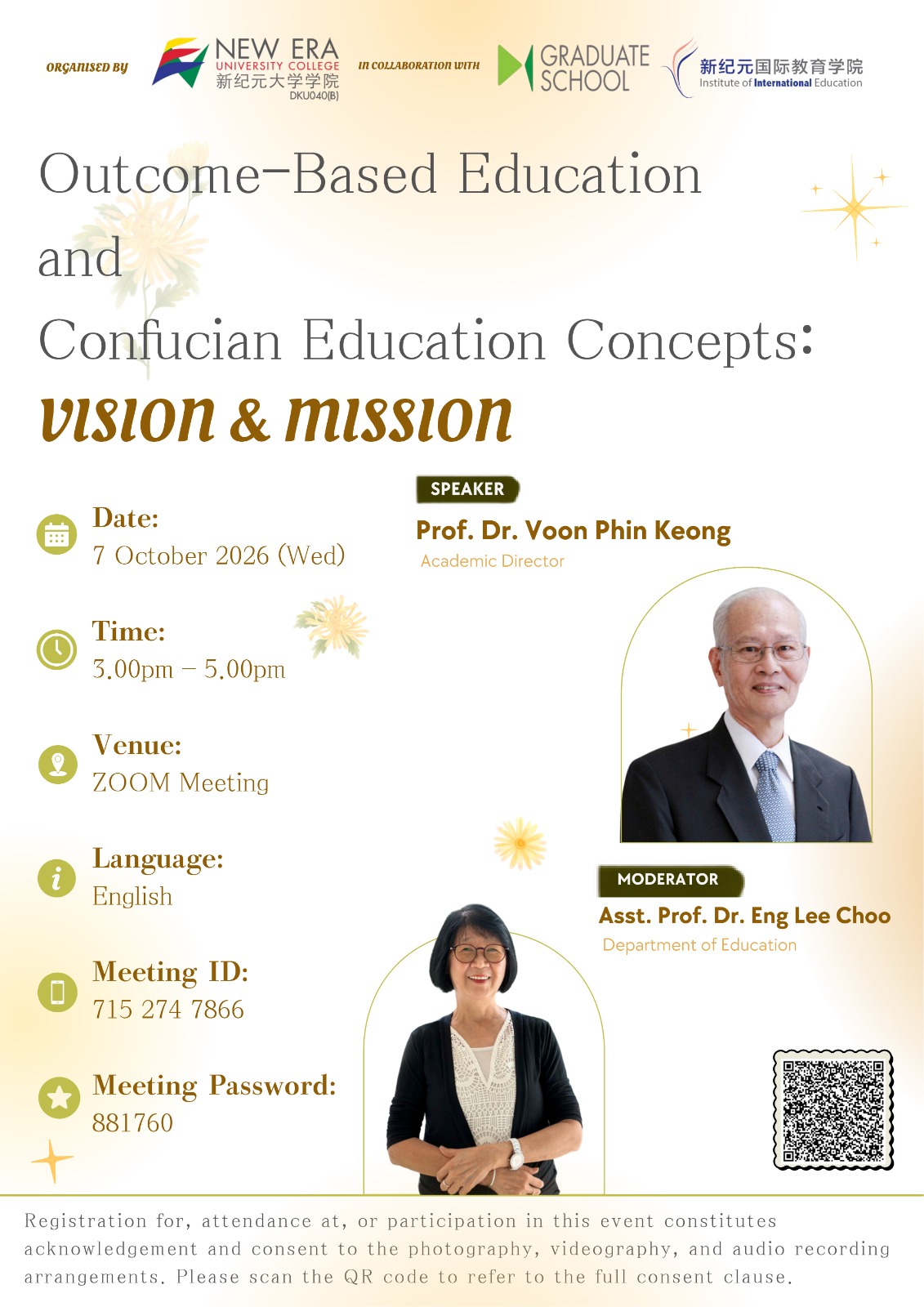
| Introduction | The “Bridging Ideas: Research Workshop Series” is a significant academic initiative meticulously planned and executed by the Faculty of Arts and Social Sciences, the Graduate School, and the Institute of International Education of New Era University College. It aims to provide current postgraduate students with a series of highly practical and effective research methodology guides. Through systematic course design and the integration of resources from multiple fields, the workshops not only help students master core research skills but also focus on enhancing their ability to address challenges encountered during the research process. Whether it is in the stages of topic selection, application of methodologies, data analysis, or thesis writing, the workshops strive to offer comprehensive support, making their research journey smoother and more fruitful. This series serves as a vital resource to empower students and ensure their academic success. |
| Speaker | Prof. Dr. Voon Phin Keong (Academic Director, NEUC) Prof. Dr. Voon Phin Keong is Academic Director at New Era University College. He previously served as Professor of Geography and East Asian Studies at the University of Malaya and held visiting and fellowship positions at leading institutions in the UK, Japan and Korea. His research focuses on Malaysian Chinese studies, Southeast Asian studies, human geography, and Malaysian development. His major publications include Western Rubber Planting Enterprise in Southeast Asia, 1876–1921, Calling Malaysian Home: Studies on Malaysian Chinese, and Chinese Population in Malaysia: Trends and Issues. |
| Moderator | Asst. Prof. Dr. Eng Lee Choo (Department of Education, NEUC) Asst. Prof. Dr. Eng Lee Choo is an Assistant Professor specialising in Language and Linguistics, and Education. She holds a Master of Education from Universiti Malaya, and Doctor of Philosophy in Chinese Studies, Universiti Tunku Abdul Rahman (UTAR). Her research interests include teacher education, professional ethics, and socio-cultural studies. Her publications include Penang’s Hakka Millionaires Row and A Study on Culturally-Loaded Linguistic Landscape Translation from the Perspective of Bassnett’s Cultural Translation Theory. |
| Topic | Outcome-Based Education and Confucian Education Concepts: Vision and Mission Outcome-based education (OBE) and the Confucian education concepts (CEC) have their own visions and missions. OBE is the current approach in education while CEC was practised in ancient China. Their pedagogical principles and approaches bear certain similarities, but their broader visions and missions are different. This seminar is a broad attempt to highlight briefly the key features of OBE and to make a dip into the core concepts as practised in the teaching methods of Confucius (551-479 BC). Confucius was an iconic thinker and philosopher and the revered “master teacher” of Chinese history. OBE is deliberately focused on enabling students to acquire and apply knowledge and skills effectively and professionally to contribute to society, CEC is equally focused on nurturing the “ideal” person to contribute to the making of an “ideal” society existing under “great harmony.” Both approaches have their pros and cons. OBE is concerned with technical problems such as how to determine and define “outcomes”, what are suitable and what are not as well as how to measure their effectiveness. CEC includes contents and teaching methods that are capable of being adapted to changing times and situations. Some familiarity with CEC may yield insights into education in the contemporary world. Rather than adopting OBE without question, it may be advisable to refer to the wisdom and experience of CEC to improve, raise and enhance modern education. |
| Information | Date: 7 October 2026 (Wednesday) Time: 3:00pm – 5:00pm Venue: ZOOM Meeting Language: English |
Lecture Postscript
Outcome-Based Education and Confucian Educational Philosophy: Vision and Mission
Prof. Dr. Voon Phin Keong Explores Outcome-Based Education and Confucian Educational Philosophy: Vision and Mission
New Era University College (NEUC) organised the 15th session of its Bridging Ideas: Research Workshop Series on 7 October 2026, featuring a talk titled “Outcome-Based Education and Confucian Education Concepts: Vision and Mission.” Delivered by Prof. Dr. Voon Phin Keong from NEUC, the online workshop explored the similarities and differences between Outcome-Based Education (OBE) and Confucian Education Concepts (CEC), highlighting their respective approaches to educational goals, values, and missions. The session was conducted in English and moderated by Asst. Prof. Dr. Eng Lee Choo from the Department of Education.
During the workshop, Prof. Dr. Voon began by outlining the core characteristics of OBE before examining the educational philosophy of Confucius. He explored the similarities and differences between the two approaches in terms of educational principles, teaching methodologies, and the cultivation of individuals. He pointed out that although OBE and Confucian education emerged from different historical contexts, they share common ground in educational practices and social responsibility while maintaining distinct visions and missions. This reflects the notion of “harmony without uniformity,” whereby different educational philosophies can complement one another while preserving their unique characteristics.
Prof. Dr. Voon further explained that OBE emphasises clearly defined learning outcomes and effective assessment mechanisms, focusing on students’ mastery and practical application of knowledge and skills to meet societal needs. Confucian education, in contrast, places greater emphasis on holistic personal development, moral cultivation, character formation, and social responsibility, with the broader aspiration of fostering a harmonious society. He highlighted that while contemporary education increasingly prioritises measurable learning outcomes and teaching effectiveness, the humanistic and ethical values embedded in Confucian educational thought continue to offer valuable insights for educators today. Rather than being mutually exclusive, both approaches can contribute to educational development from different perspectives.
Through a comparative exploration of ancient and modern educational philosophies, the workshop encouraged participants to reflect on how traditional educational wisdom could enrich contemporary educational practices. It also highlighted the importance of balancing knowledge acquisition and skills development with character formation and social responsibility. At the end of the session, Prof. Dr. Voon engaged with the moderator and participants in further discussions on related educational issues, bringing the workshop to a successful conclusion. The workshop commenced punctually at 3:00 p.m., lasted one and a half hours, and concluded smoothly at 4:30 p.m., attracting approximately 45 participants on the Zoom platform.

