
Lecture by Dr. Donald Chan Hong Yin in the 54th talk of the “Tan Lark Sye Lecture Series”
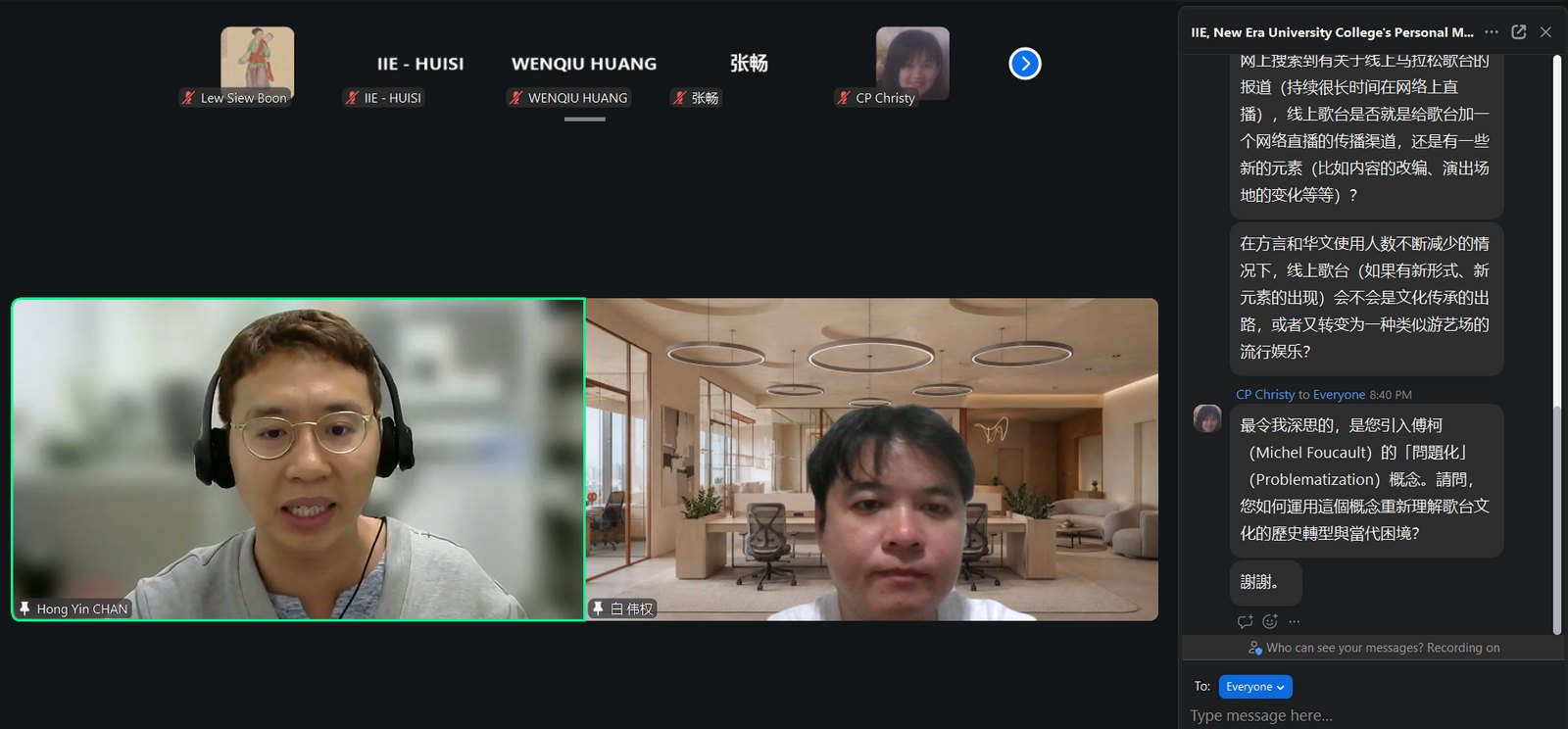
The 54th session of the Tan Lark Sye Lecture Series, organized by the Institute of International Education and the Tan Lark Sye Institute of New Era University College (NEUC), was held on 28 October. The session featured Dr. Donald Chan Hong Yin, Lecturer in Hong Kong Metropolitan University, Department of Social Science, as the keynote speaker, delivering a lecture titled “From ‘Getai’ to ‘Seventh lunar month Getai’: The transformation of ‘Getai’ in Singapore (1940s-1980s).” The session was chaired by Associate Professor Dr. Pek Wee Chuen, Head of the Department of Southeast Asian Studies and an Associate Professor in the Department of Chinese Language and Literature at New Era University College, the session drew over 120 participants. In her presentation, Dr. Donald explored the historical development of getai in Singapore, focusing on its evolution from entertainment in amusement parks to an integral part of the Ghost Festival during the seventh lunar month, serving as a cultural activity that honours deities, entertains audiences, and strengthens community ties.
Dr. Donald obtained his bachelor’s and Master of Philosophy degrees from the Department of Humanities and Creative Writing at Hong Kong Baptist University, and his PhD from the Department of Chinese Studies at the National University of Singapore. He subsequently conducted postdoctoral research in the Department of East Asian Studies at Tel Aviv University, Israel. He is currently a Lecturer in the Department of Social Sciences, Wu Jieh Yee School of Arts and Social Sciences, Hong Kong Metropolitan University. His research focuses on Chinese popular religion and Chinese diaspora studies, particularly the history and culture of Cantonese communities in Singapore and Malaysia from the nineteenth century to the present. He has published several academic articles in these fields.
In this lecture, Dr. Donald drew on historical materials from Chinese-language newspapers, including Shin Min Daily News and Nanyang Siang Pau, to trace changes in getai’s performance spaces, content, and social roles. He explained how the rise of television and the decline of amusement parks gradually brought getai onto the streets, where it became increasingly integrated into Ghost Festival celebrations during the 1960s and gained widespread popularity in the 1970s. He also examined the interaction between state governance and folk cultural practices, exploring how getai participants adapted to changing social norms and language policies while sustaining the cultural identity of Chinese communities, particularly the Hokkien community.
Following the lecture, Dr. Donald engaged in an in-depth discussion with the moderator on research methodology during the question-and-answer session. The questions and responses further enriched the discussion, helping the audience gain a fuller understanding of how Seventh Month Getai has continually adapted its performance formats and modes of dissemination to different historical contexts.