
Outcome-Based Education and Confucian Educational Philosophy: Vision and Mission Prof. Dr. Voon Phin Keong Explores Outcome-Based Education and Confucian Educational Philosophy: Vision and Mission
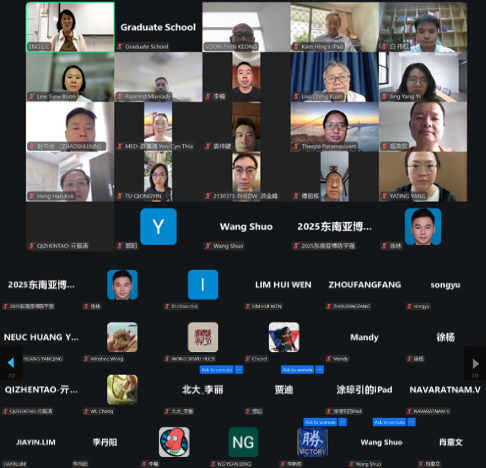
New Era University College (NEUC) organised the 15th session of its Bridging Ideas: Research Workshop Series on 7 October 2026, featuring a talk titled “Outcome-Based Education and Confucian Education Concepts: Vision and Mission.” Delivered by Prof. Dr. Voon Phin Keong of NEUC, the online workshop explored the similarities and differences between Outcome-Based Education (OBE) and Confucian Education Concepts (CEC), highlighting their respective approaches to educational goals, values, and missions. The session was conducted in English and moderated by Asst. Prof. Dr. Eng Lee Choo from the Department of Education.
During the workshop, Prof. Dr. Voon began by outlining the core characteristics of OBE before examining the educational philosophy of Confucius. He explored the similarities and differences between the two approaches in terms of educational principles, teaching methodologies, and the cultivation of individuals. He pointed out that although OBE and Confucian education emerged from different historical contexts, they share common ground in educational practices and social responsibility while maintaining distinct visions and missions. This reflects the notion of “harmony without uniformity,” whereby different educational philosophies can complement one another while preserving their unique characteristics.
Prof. Dr. Voon further explained that OBE emphasises clearly defined learning outcomes and effective assessment mechanisms, focusing on students’ mastery and practical application of knowledge and skills to meet societal needs. Confucian education, in contrast, places greater emphasis on holistic personal development, moral cultivation, character formation, and social responsibility, with the broader aspiration of fostering a harmonious society. He highlighted that while contemporary education increasingly prioritises measurable learning outcomes and teaching effectiveness, the humanistic and ethical values embedded in Confucian educational thought continue to offer valuable insights for educators today. Rather than being mutually exclusive, both approaches can contribute to educational development from different perspectives.
Through a comparative exploration of ancient and modern educational philosophies, the workshop encouraged participants to reflect on how traditional educational wisdom could enrich contemporary educational practices. It also highlighted the importance of balancing knowledge acquisition and skills development with character formation and social responsibility. At the end of the session, Prof. Dr. Voon engaged with the moderator and participants in further discussions on related educational issues, bringing the workshop to a successful conclusion. The workshop commenced punctually at 3:00 p.m., lasted one and a half hours, and concluded smoothly at 4:30 p.m., attracting approximately 45 participants on the Zoom platform.