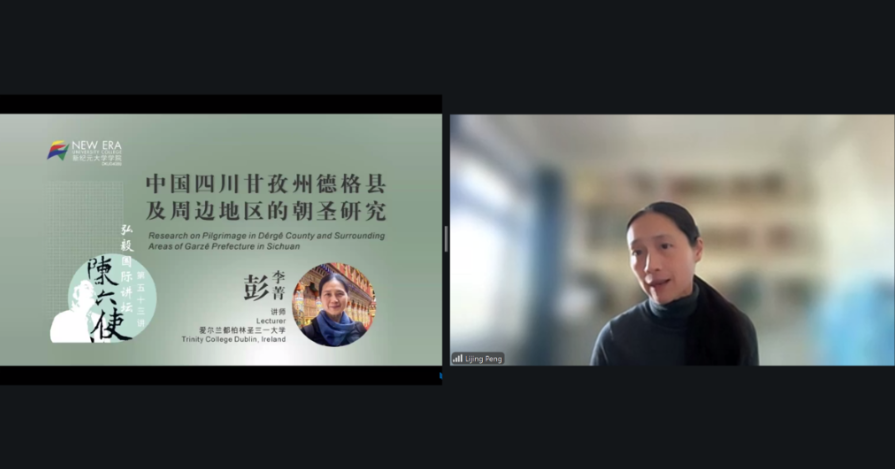
Lecture by Dr. Lijing Peng in the 53rd talk of the “Tan Lark Sye Lecture Series”
The 53rd session of the Tan Lark Sye Lecture Series, organized by the Institute of International Education and the Tan Lark Sye Institute of New Era University College (NEUC), was held on 30 September. The session featured Dr. Lijing Peng, Lecturer at the Trinity Center for Asian Studies, Trinity College Dublin, as the keynote speaker, delivering a lecture titled “Research on Pilgrimage in Derge County and Surrounding Areas of Garze Prefecture in Sichuan”. The session was chaired by Associate Professor Dr. Lew Siew Boon, Assistant Dean of Institute of International Education at New Era University College, the session drew over 110 participants. In her presentation, Dr. Lijing Peng offered an in‑depth exploration of Derge County’s distinctive position as a major pilgrimage destination in the Tibetan region, highlighting its religious traditions, scholarly history, and geopolitical background.
Dr. Lijing Peng completed her undergraduate studies at Peking University and received her PhD in Anthropology from the National University of Ireland in 2015. Her long‑term research focuses on linguistic anthropology and semiotic anthropology, with publications covering literature, mythology, semiotic landscapes, language ideology, and epic performance. She has conducted ethnographic fieldwork in minority regions including Western Hunan, Sichuan, and Gansu. In recent years, her research has centred on pilgrimage and cultural institutions in Derge Town, located in the Kham region of Ganzi Tibetan Autonomous Prefecture, Sichuan. Dr. Lijing Peng co‑founded the European Linguistic Anthropology Network and currently serves on the editorial board of Semiotic Review. Since 2017, she has been an Assistant Lecturer at the Centre for Literary and Cultural Translation at Trinity College Dublin. Beginning in 2024, she also teaches at the Trinity Centre for Asian Studies under the School of Linguistic, Speech and Communication Sciences, offering courses on comparative linguistic philosophy, Chinese mythology, and regional cultures of China, while supervising postgraduate students at both centers.
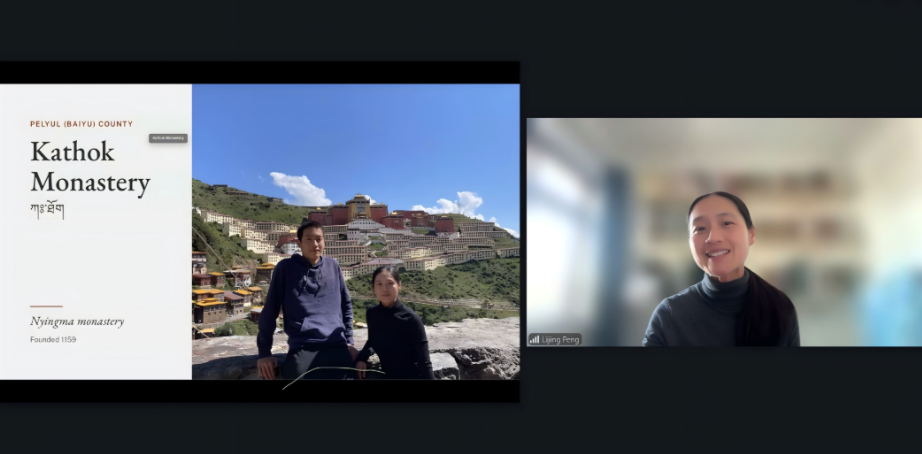
In this lecture, Dr. Lijing Peng approached the topic from three perspectives which is religious practice, scholarly tradition, and geopolitical structure. She provided a systematic introduction to the historical and cultural significance of the Derge Printing House, the formation of local pilgrimage networks, and the social functions and meanings of pilgrimage activities in the region. Drawing on her long‑term fieldwork in Derge, she offered insights that help the public better understand the area’s pivotal role within the religious and cultural landscape of Kham and the wider Tibetan region. Following the lecture, Dr. Peng engaged in an in-depth discussion with the moderator on research methodology during the Q&A session. The audience's questions and responses further deepened the lecture's scope, enabling attendees to gain a more comprehensive understanding of Derge's pivotal role within the religious and cultural system of the Tibetan region.