
【24th Book Sharing:】Ten Lectures on Historical Geography
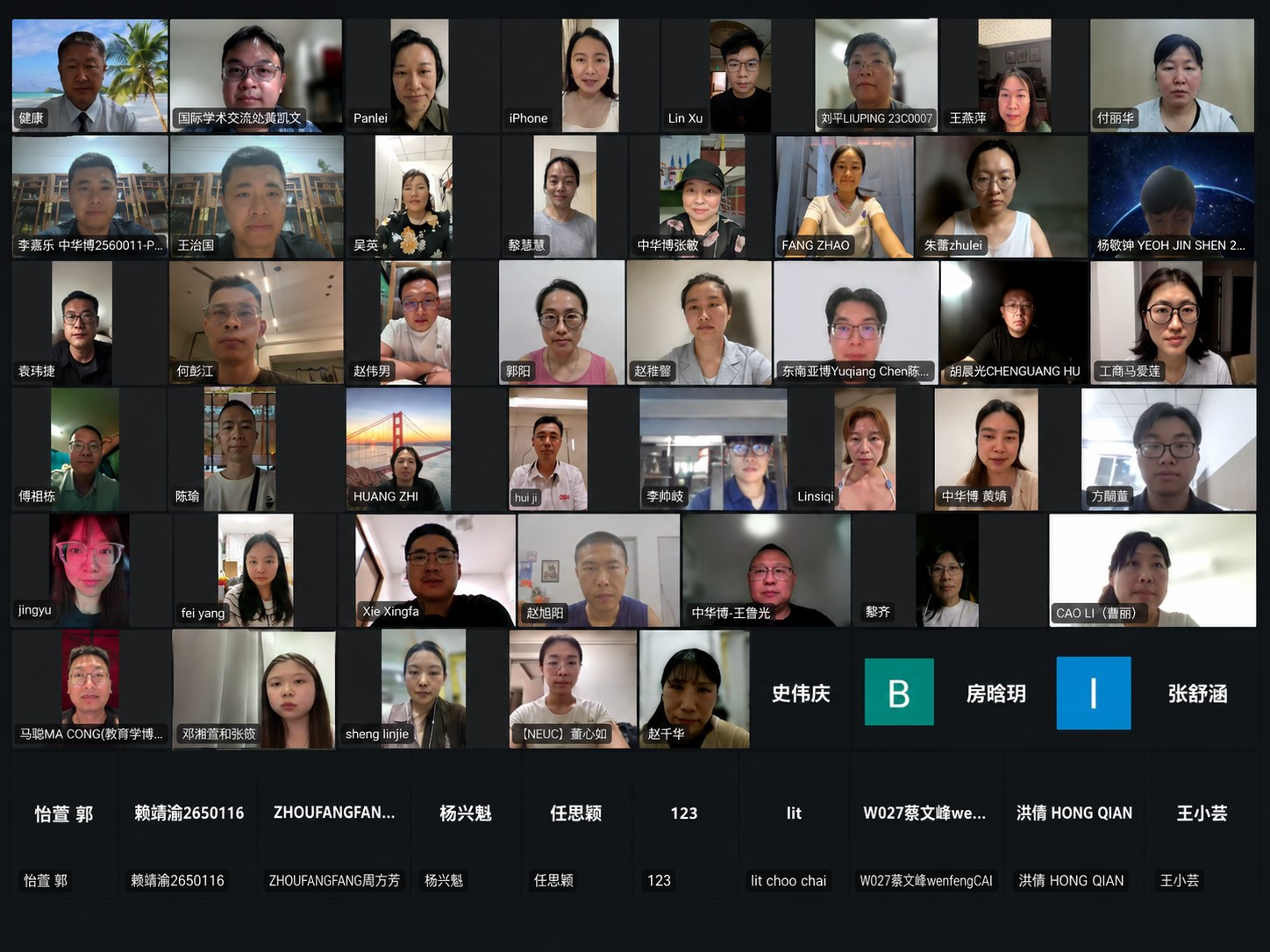
On 18 June 2026, the Institute of International Education of New Era University College (NEUC) held its 24th Book Sharing Session via Zoom. The session invited Assoc. Prof. Dr. Kang Jianjun, Visiting Scholar at the Faculty of Arts and Social Sciences of NEUC, to guide participants through Shi Nianhai’s classic work, Ten Lectures on Historical Geography.
Centered on the theme of “How history enters geography, and how geography explains history,” the session encouraged participants to revisit the development of Chinese history from the perspectives of space, environment, and regional transformation. Assoc. Prof. Dr. Kang first introduced Shi Nianhai’s important role in the establishment and development of modern historical geography in China. He pointed out that Ten Lectures on Historical Geography connects the core issues of ancient Chinese historical geography through ten thematic lectures. The topics covered include differences between ancient and modern climates, population migration, the territorial scale of dynasties, capital construction and urban evolution, transportation routes during the Spring and Autumn period, the economic development of the Yellow River Basin and the Yangtze River Delta, Hexi and Dunhuang, as well as the ecological imbalance of the Loess Plateau. Through these key themes, readers are able to observe the complex interactions among the natural environment, political power, transportation networks, and economic regions.
During the sharing session, he emphasized that historical geography is not merely a description of landscapes, geographical features, or the evolution of place names. Rather, it uses rich historical materials and a spatial perspective to analyze the formation of population movements, regional development, and patterns of civilization across different historical periods. Drawing on his own research experience in cultural geography, he also explained that historical geography can provide important methodological insights for literary geography, cultural studies, and regional social research.
The session not only broadened students’ understanding of historical geography but also demonstrated the value of the Book Sharing Session as a platform for interdisciplinary reading and academic exchange.